
Leave a Comment
Your email address will not be published. Required fields are marked *
The Asian Council of Science Editors (ACSE) is pleased to support Peer Review Week (PRW) 2026, taking place from 14 to 18 September 2026.
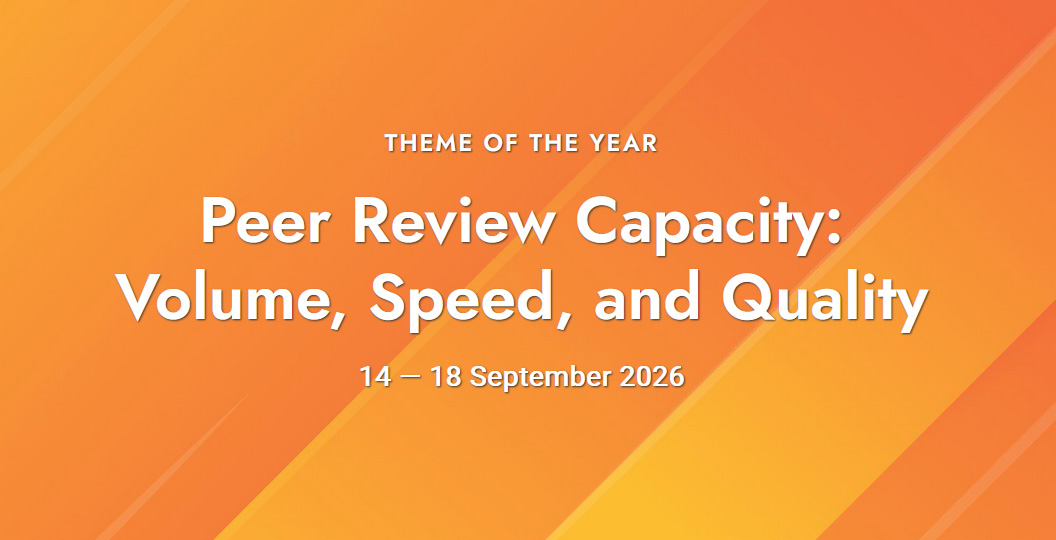
This year’s theme, “Peer Review Capacity: Volume, Speed, and Quality,” reflects a shift already visible across the scholarly publishing landscape. The question no longer centres only on how peer review functions, but on how it continues to operate effectively under growing demands.
When Growth Outpaces the System
Across journals and disciplines, submission volumes continue to rise while expectations around speed have intensified. The structure of peer review, however, has not expanded at the same pace.
This imbalance now shapes day-to-day editorial practice. Tighter timelines, increasing reviewer requests, and expanding submission pipelines are no longer occasional pressures but routine conditions under which peer review operates.
Looking Beyond Volume
Framing the issue purely in terms of numbers risks missing what is actually changing.What comes into focus instead is how peer review functions under pressure.
Editorial workflows, reviewer engagement, and decision-making processes are all being shaped by competing expectations. When speed becomes a defining factor, maintaining quality requires deliberate effort rather than assumption.Without attention to these underlying structures, increasing output alone cannot sustain the system.
Whose Capacity Are We Talking About
These pressures do not unfold in the same way everywhere. In many parts of Asia and other underrepresented regions, editorial teams manage growing submission flows without proportional expansion in reviewer pools or infrastructure. Expectations to align with global standards continue to rise within uneven conditions.
As participation in global research expands, the question shifts from scale to suitability. Whether current peer review models adequately reflect the diversity of the system they support remains an open and necessary discussion.
Speed, Quality, and the Risk of Silent Trade-Offs
Within this environment, the balance between speed and rigor becomes increasingly difficult to maintain.
Faster decisions are often necessary. Yet when timelines tighten without additional support, adjustments begin to appear in practice. Reviewer fatigue becomes more visible, reliance on a limited pool of contributors increases, and editorial thresholds may shift under pressure.
These developments do not signal failure. They indicate that the system is operating close to its limits.
From Awareness to Collective Response
Peer Review Week 2026 provides an opportunity to move beyond recognition of these pressures toward a more coordinated response.
For ACSE, this includes creating space to bring regional perspectives into global discussions, sharing editorial experiences that are often underrepresented, and exploring approaches that reflect varied publishing contexts.
As a supporting organization of Peer Review Week, ACSE invites its members and the wider scholarly community to take an active role in PRW 2026.
ACSE encourages participation through the following avenues:
Whether through writing, discussion, or multimedia contributions, each perspective adds to a broader and more inclusive conversation on the future of peer review.
Continuing the Conversation
For full details on the theme and ways to participate, visit:
A Moment to Reassess
The pressures on peer review are unlikely to diminish in the near term. What can evolve is how the community responds.
Peer Review Week 2026 offers an opportunity to examine not only how much the system can manage, but how it can adapt in ways that are sustainable, inclusive, and aligned with the realities of a global research environment.

Maryam Sayab is the Director of Communications at the Asian Council of Science Editors (ACSE) and Co-Chair of Peer Review Week. With a background rooted in research integrity and publication ethics, she actively works to advance regional conversations around responsible peer review, transparent editorial practices, and inclusive open science. Maryam is dedicated to building bridges between global publishing standards and the practical realities faced by researchers and editors, especially across Asia and the Arab world. She also supports initiatives that strengthen community-driven collaboration, ethical scholarship, and the sustainable development of research ecosystems.
View All Posts by Maryam SayabThe views and opinions expressed in this article are those of the author(s) and do not necessarily reflect the official policy or position of their affiliated institutions, the Asian Council of Science Editors (ACSE), or the Editor’s Café editorial team.

How should we report a warning that artificial intelligence could end humanity within a few years? Paying attention seems...
Read more ⟶
For many journal editors, inclusion in an international indexing database is the culmination of years of hard work. It refle...
Read more ⟶
The title and section headings intentionally echo the Harry Potter series. The literary allusion is playful, but the mess...
Read more ⟶